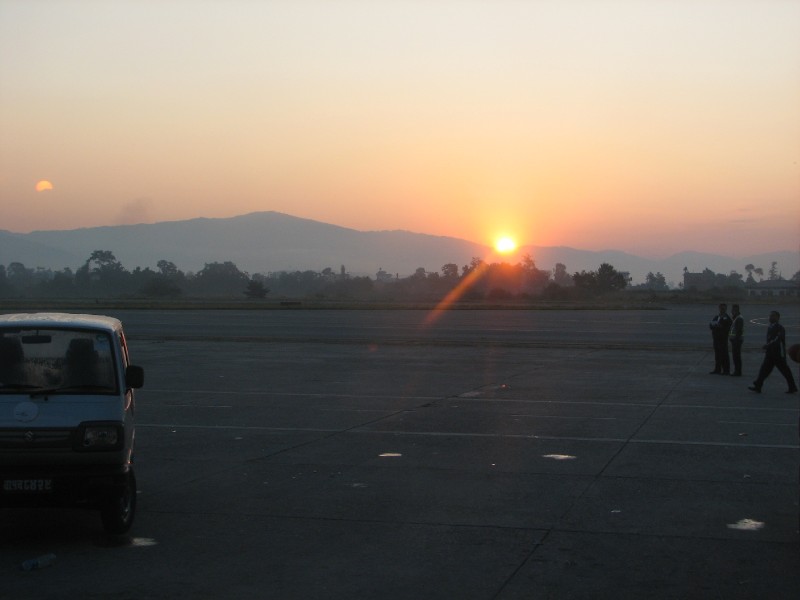
 Sunrise from Kathmandu
airport
Sunrise from Kathmandu
airport Everest Base Camp 2008 - Arrive Kathmandu and Fly to Lukla
As luck would have it, we got a window seat on the right hand side of the Airbus 320 Silk Air flight from Singapore to Kathmandu that flew in bright morning sunlight. As the flight neared Nepal, the Himalayan peaks came into view. Having studied the geography of the range carefully in preparation for our trip, we could easily identify the snow-covered mountain that stretched itself over a wide area as Kangchenjunga (8586m/28169ft.). The fact that this is the easternmost 8000+ peak made it easier to identify it. Kangchenjunga is the 3rd highest peak on the planet and before 1848 (when Everest was measured to have a higher altitude ) was thought to be the highest peak on earth.
Panning left, we could identify Makalu (5th highest at 8462m/27765ft.), and then the tightly bound group of Lhotse (4th highest at 8516m/27940ft.) and Everest (Highest at 8850m/29035ft.). And finally the last two high peaks in the range Gyachung Kang (16th highest int he world at 7922m) and Cho Oyu (6th highest at 8153m).
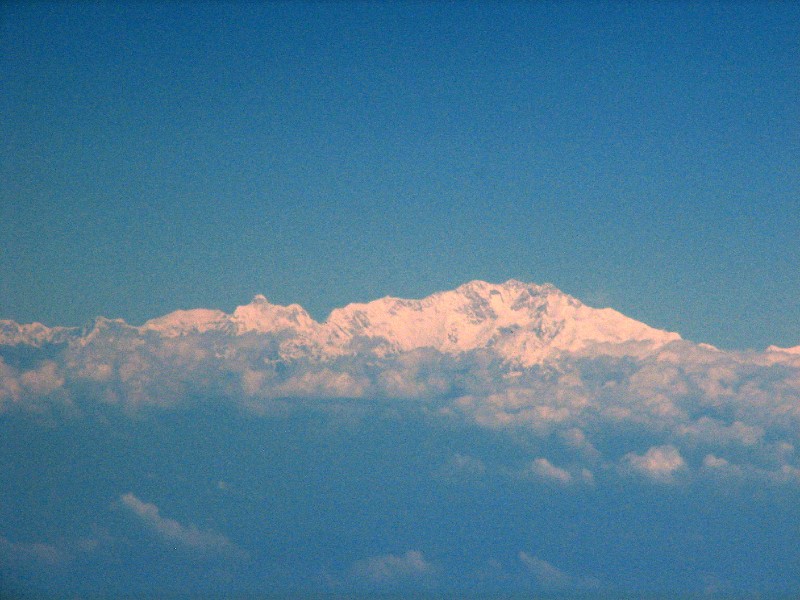 Kangchenjunga
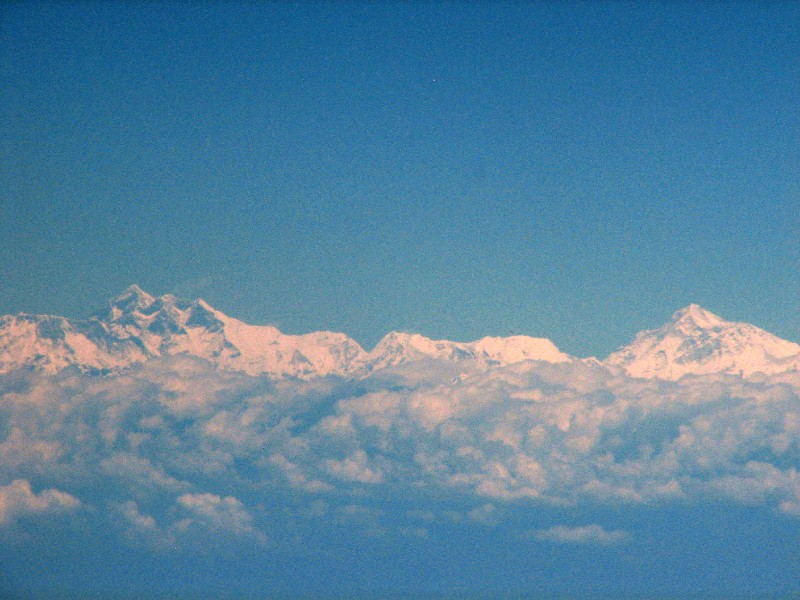 l-to-r :
Everest/Lhotse (tight knit group) and Makalu
l-to-r :
Everest/Lhotse (tight knit group) and Makalu 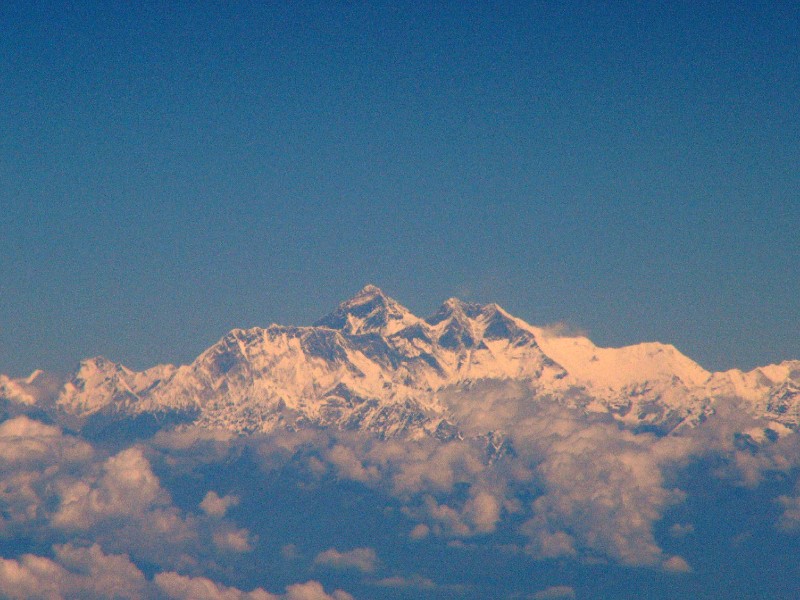 Everest and
Lhotse
Everest and
Lhotse We would later view Makalu, Lhotse and Everest up close from various points in the Khumbu Valley over the next few days. This was a good preview and an unexpected bonus.
That afternoon, we walked from our Thamel hotel to Asahi Treks, which was the company managing our trip. We met our guide, Devendra and were given our flight tickets to Lukla and a briefing on the schedule. We hadn't shirked on the preparation and were more than ready. Our guide would pick us up the next morning at 5:15 to catch the 6:15 flight to Lukla. It was private group with just the 2 of us to be accompanied by the guide and a porter who will be hired in Lukla.
We spent the afternoon exploring Thamel and walked to Durbar Square (World Heritage Site) which was full of temples with typical Nepali architecture. The crowds there showed scant respect for the place and it was filled with litter. There was a power outage after twilight and we walked back to our hotel in darkness illuminated by the shops that were lit by generators. Power returned after we reached the hotel, but went out again in the morning.
We flew Agni Airlines (strange for an airline to be named after a fire god...what next, Swaha Air?) which was a Dornier 228 aircraft seating about 18 people. These are STOL (Short Take Off and Landing) aircraft which can handle very short runways like the one at Lukla. Our guide told us that Agni only has 2 planes for the Lukla sector and it just keeps flying back and forth between KTM and Lukla till it runs out of waitlists (which never happens) or bad weather (which happens a lot).
Even though we had a reservation on the 6.15 am flight from KTM to Lukla on Oct. 21st, we landed up at the airport domestic terminal (which only opened at 5:45 am!) and were told that our flight had been chartered by a private group and we will be on the next one. The schedule said something like 7:45 am and it was more or less accurate. But we were kept guessing in the departure hall which was quite chaotic. Everybody was announcing some departure (Buddha Air! Yeti Air! Gorkha Air! Sita Air!). Some of these are "mountain" flights where people sit on window seats and are shown all the mountains without having to do any trekking. Great option if you have only a few days in Kathmandu. Despite all this confusion, the sun came up reassuringly.
Sunrise from Kathmandu
airport
When Agni announced the next Lukla flight, we got all excited and approached the guy with our passes. He said that it was not "our" flight and asked us to sit down. Our guide told us that "our" flight will be the "other" plane and will leave in about 15 mins. We never believed a word of this, but it all actually turned out to be true. We strained at the leash to get to the preferred seats on the starboard side of the plane but found that several others were trying the same. One of us (Malini) succeeded in getting a left side seat right behind the pilot (the seat right behind the pilot had a big cargo bag on the seat) and the other (Venkatesh) could get on to the seat rows behind her. Once the plane took off, within seconds, you get to see the mountains. We were not too familiar with all of them, but it was stunning to see them anyway. We could follow the mountain highways and the rice cultivations and the towns on the way. After 25 minutes or so, the plane went over a cliff and then we looked over the pilot's shoulder and saw the Lukla landing field.
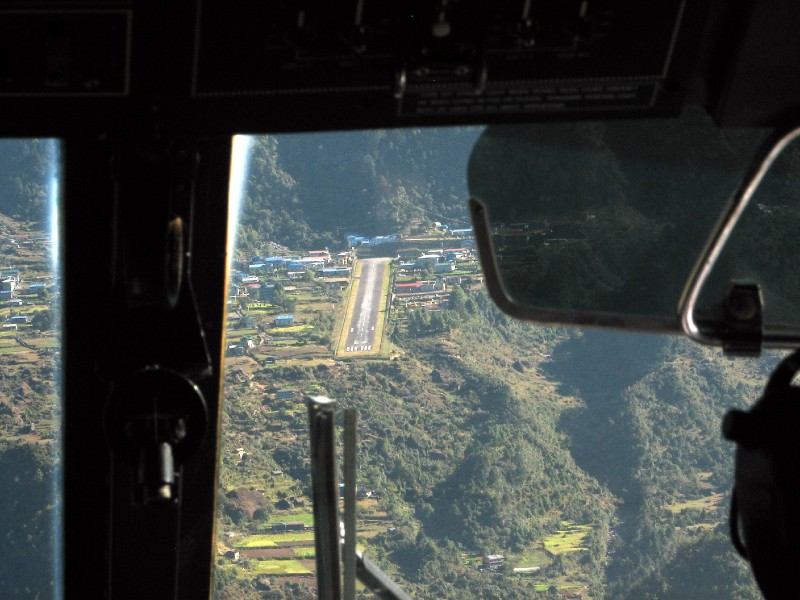 Lukla runway from Agni
Airlines (Dornier 228) cockpit
Lukla runway from Agni
Airlines (Dornier 228) cockpit
As the plane dove towards this strip, we had our cameras ready but the best we got was a big THUD as the plane touched down on the near vertical runway and then impossibly slowed down with a huge reverberating roar and smartly turned into the parking area where there was space for 4 planes. We jumped off and within minutes, it had loaded up departing passengers and cargo and was wheels off on the vertical runway going downhill and without any fuss, gently climb over the surrounding mountains on its return journey to Kathmandu.
Before we knew it, our guide had hired a young porter who had our pack on his back. We went around the runway fence towards Khumbu Resort Lodge. We shot a video of an incoming Yeti Airlines plane. We had our first mountain breakfast at the restaurant which had a partial, sideways view of the runway. While sipping Lemon Tea and waiting for our breakfast, we shot another video of a departing Agni Airlines plane.
Landing at Lukla (uncontrolled video, everything hazy but
the THUD is quite perceptible)
Yeti Airlines landing at Lukla
Agni Airlines takeoff from Lukla
After breakfast, we were ready to
start Day 1 of our trek to the base of Mount Everest.
| <--Prev |